
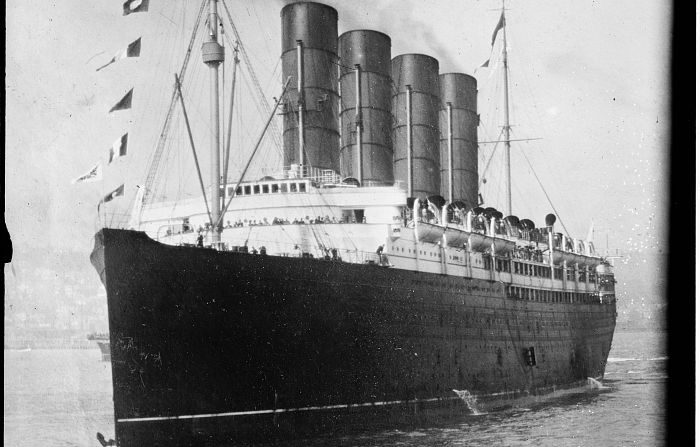

Today marks the 110th anniversary of the sinking of the R.M.S Lusitania, one of the more forgotten historical events of the early 20th century. In my opinion, it is often times the more forgotten aspects of history that are the most influential.
When most people think about sinking ships or sunk ocean liners/cruise ships, their immediate thoughts dart to the R.M.S Titanic. This can be expected primarily thanks to Hollywood’s influence on the subject. Despite this, there are many historical shipwrecks that are just as influential and interesting as Titanic’s.
The Context
Launched in 1906, The R.M.S Lusitania was an ocean liner owned and operated by the British Cunard Line. When she was first built, the Lusitania was the largest ship ever constructed. The R.M.S Olympic (Titanic’s sister ship) would take that record a few years later in 1911.
On May 1, 1915, Lusitania departed New York on what would be her final voyage. Although the trip was considered to be routine, the recent declarations and warnings posed by Germany regarding submarine warfare were ever present in the minds of those aboard.
Despite this, the ship would depart the New York harbor and begin the seven-day journey across the northern Atlantic Ocean to Liverpool in the United Kingdom.

Image sourced from the Library of Congress Archives
The Sinking
It was a sunny morning on May 7, 1915. Despite the ongoing war, the seas were calm. Passengers strolled the decks and musicians performed songs all while lookouts kept a vigilant eye for any suspicious activity on the waves.
What passengers initially thought was just the splashing of a herd of dolphins, quickly was revealed to be the bubbling of an incoming torpedo from the ship’s starboard (right) side. In an instant, the torpedo tore its way into the side of the ship, sending debris and plumes of smoke into the air. Chaos ensued, as passengers ran to the boat deck to attempt to get into lifeboats.
The explosion of the torpedo caused far more damage than could have been expected. The ships’ power almost immediately went out, leaving some passengers in the ship’s elevators stuck in darkness.
Lifeboats were deployed, although only 6 of the 48 actually made it off the ship. In just 15 minutes, Lusitania slipped beneath the waves. For comparison, Titanic took almost 3 hours to sink.
To make matters even worse, due to the now very prevalent threat of attack by German submarine, it would take allied ships almost a day to rescue any survivors of the disaster.

Image sourced from the Library of Congress Archives
Aftermath
In total, 1,197 out of the ship’s 1,960 passengers were killed.
Although the sinking of the Lusitania did not officially cause the United States to enter World War I, it was still a major tipping point in public opinion on the U.S.’s neutrality in it. From the point of the sinking onward, the public would slowly turn towards the opinion of involvement in the war.
Remnants
Unlike the wreck of the Titanic, the wreck of the Lusitania is far from being recognizable. Partly because of its extreme rate of sinking, air trapped in the ship eventually exploded outwards. This paired with the relatively shallow depth of the water it rests in, the high sea currents of the area, and damage from depth charges used during the war, have caused the wreck to look like a mangled mess of steel.
Despite its historical significance, there have also been several attempts to salvage the wreck for its materials, both legal and illegal.
One salvage operation in 1982 was able to recover three of the ship’s four propellers. Although one was melted down, the other two are currently on public display.
Why there?
Oddly enough, there is a remnant of this historical event in, out of all places, the courtyard of a Hilton hotel. One of the Lusitania’s bronze propellers can be found at the Hilton Anatole in Dallas, Texas. The story of how this artifact made it to this location will definitely be the subject of a future post.
For now, if you’re ever in the Dallas area, go take a look at the Lusitania’s propeller. The location on Google Maps can be found below:
In Memoriam
The sinking of the Lusitania is not an event I, personally, hear very much about. Regardless, those innocent people who lost their lives in this terrible even still deserve commemoration.
Please join me in praying for and remembering the 1,197 souls lost onboard this tragic sinking.